
Project LED Street Light
Four series, 50 to 300 W, 130 to 195 lm/W, all Class I. Type II, III and IV optics with published beam angles, drivers yours to name, and every tier in a single-piece carton. Efficacy is measured on a goniophotometer, not copied from a catalogue.
LF-LED01 — the workhorse tier, one unit to a carton
The four-tier workhorse. Every tier ships one unit per carton, so you can mix powers inside a single order without breaking a carton open. The 50 W tier takes a φ40 spigot; everything above it is φ60. Measured at 200 W: 140.09 lm/W, 28,421 lm, 0.0% upward light.
| Power | LED qty | Body (mm) | Carton (cm) | Volume | approx. per 20GP |
|---|---|---|---|---|---|
| 50 W | 60 | 470 × 180 × 110 | 53 × 24 × 12 | 0.015 m³ | 1,830 |
| 100 W | 96 | 560 × 240 × 115 | 62 × 29 × 15 | 0.026 m³ | 1,064 |
| 150 W | 150 | 690 × 280 × 130 | 74 × 34 × 15 | 0.038 m³ | 731 |
| 200 W | 216 | 740 × 280 × 130 | 79 × 34 × 15 | 0.043 m³ | 651 |
- 130–150 lm/W as standard on 3030 or 5050 chips. Up to 195 lm/W with 7070 at a 500-piece minimum per model.
- φ40 on 50 W, φ60 above it. Check your existing brackets before ordering the small tier.
- One unit per carton from 651 to 1,830 units per 20GP, depending on tier.
- 125.3° beam, 0.0% upward light — nothing goes up into windows or at the sky, whatever the audit measures.
IES file for any tier on request — we commission the test for the wattage your tender names, usually the same working day.


LF-LED03 — one 90 mm body, six tiers, 50 to 300 W
The only series that covers 50 to 300 W in six steps without changing housing depth. Same 300 mm face, same bracket, same spare-parts list from top to bottom — so you stock one shell family and still answer a 300 W line item. Measured at 150 W: 150.5 lm/W, 22,473 lm, 104.9° beam, 0.0% upward light.
| Power | LED qty | Body (mm) | Carton (cm) | Volume | approx. per 20GP |
|---|---|---|---|---|---|
| 50 W | 50 | 430 × 300 × 90 | 48 × 32 × 11 | 0.016 m³ | 1,717 |
| 100 W | 100 | 515 × 300 × 90 | 55 × 32 × 11 | 0.023 m³ | 1,217 |
| 150 W | 150 | 600 × 300 × 90 | 66 × 32 × 11 | 0.023 m³ | 1,201 |
| 200 W | 200 | 685 × 300 × 90 | 72 × 32 × 11 | 0.025 m³ | 1,106 |
| 250 W | 250 | 770 × 300 × 90 | 78 × 32 × 11 | 0.033 m³ | 848 |
| 300 W | 300 | 855 × 300 × 90 | 98 × 32 × 11 | 0.033 m³ | 848 |
- 150–195 lm/W across six tiers, 150.5 lm/W measured at 150 W. The top of that range needs a 500-piece order per model.
- 300 × 90 mm face from 50 W to 300 W — one silhouette on the pole across the whole run.
- 1,201 units per 20GP at 150 W, 848 at 250 W and above — on a 104.9° beam, for pole-at-kerb layouts.
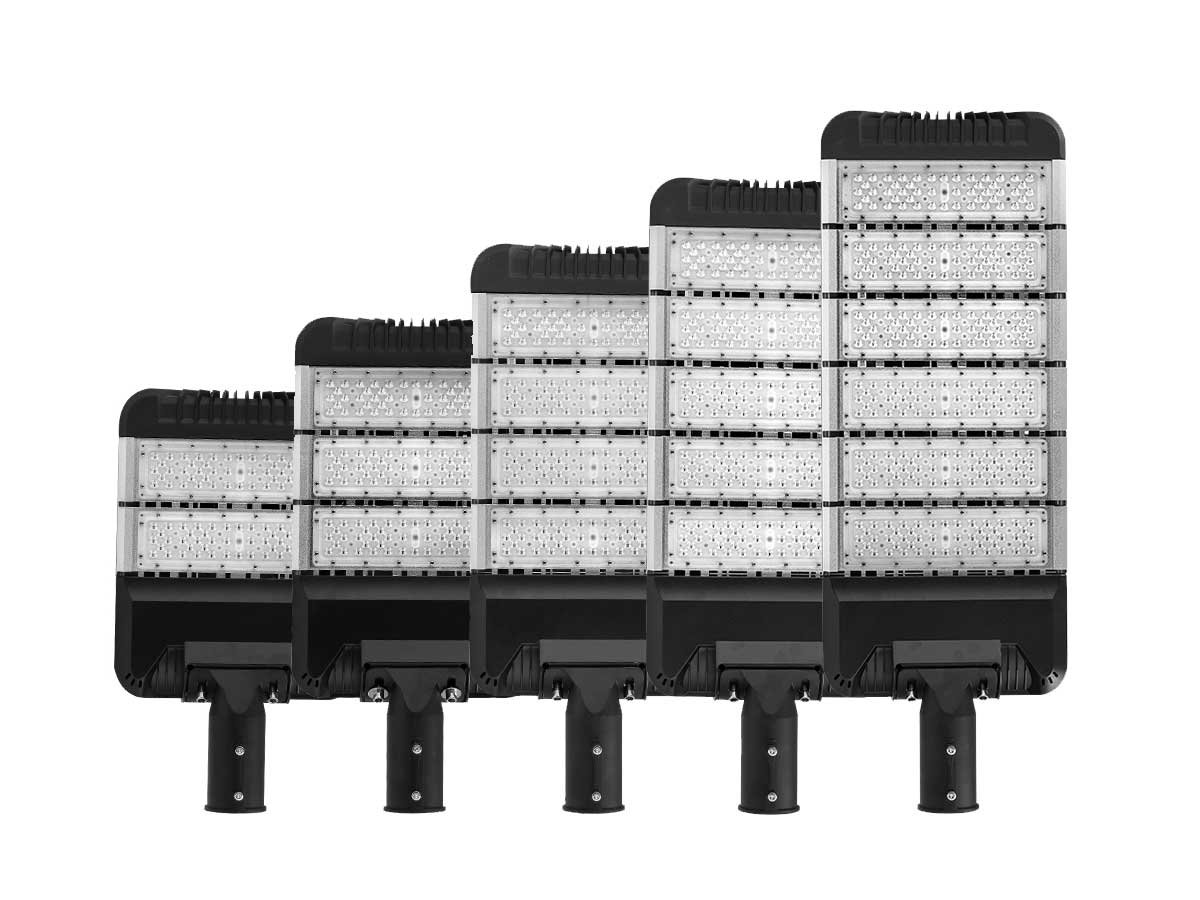

LF-LED06 — the tier that wins on connected load
195 lm/W is what you reach for when a tender scores you on installed kW rather than lumens. Measured at 100 W on 7070 chips: 190.85 lm/W, 18,549 lumens, 101.8° beam, zero upward light.
| Power | LED qty | Body (mm) | Carton (cm) | Volume | approx. per 20GP |
|---|---|---|---|---|---|
| 50 W | 72 | 600 × 230 × 93 | 64 × 26 × 11.5 | 0.023 m³ | 1,217 |
| 100 W | 144 | 650 × 230 × 93 | 67.5 × 26 × 11.5 | 0.023 m³ | 1,217 |
| 150 W | 192 | 745 × 280 × 93 | 79 × 30.5 × 11.5 | 0.028 m³ | 989 |
| 200 W | 240 | 855 × 280 × 93 | 91 × 30.5 × 11.5 | 0.032 m³ | 866 |
- Up to 195 lm/W with 7070 chips — 500-piece minimum per model.
- 72 to 240 chips across the range, on a 93 mm body throughout.
- 5050 or 7070, not 3030. The larger die spreads the same current over more area, so the junction runs cooler. 3030 will not hold 195 lm/W in this body.
- 866 to 1,217 units per 20GP — the thinnest cartons of the four series.
- 18,000-hour chip test, 94.7% retained — run at 105 °C case temperature, zero failures across 50 samples.
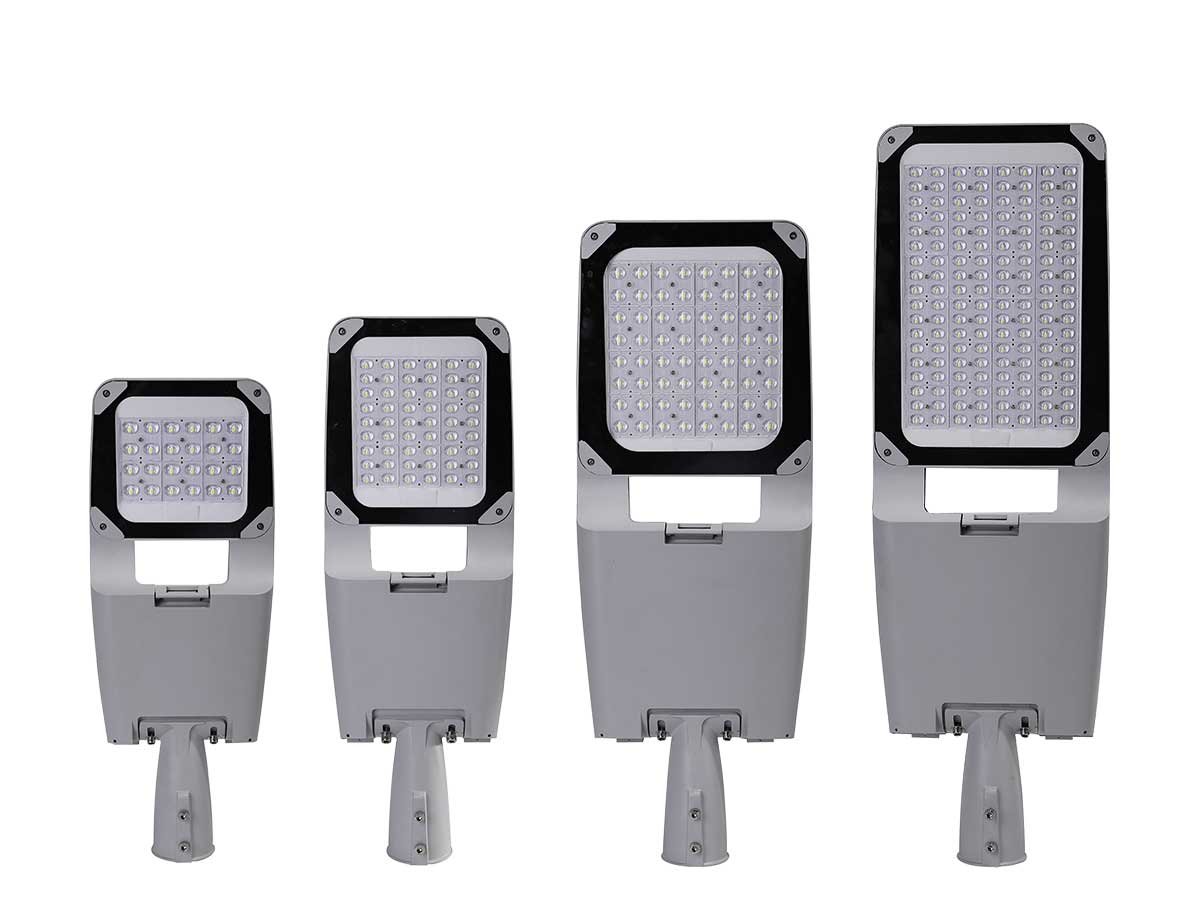
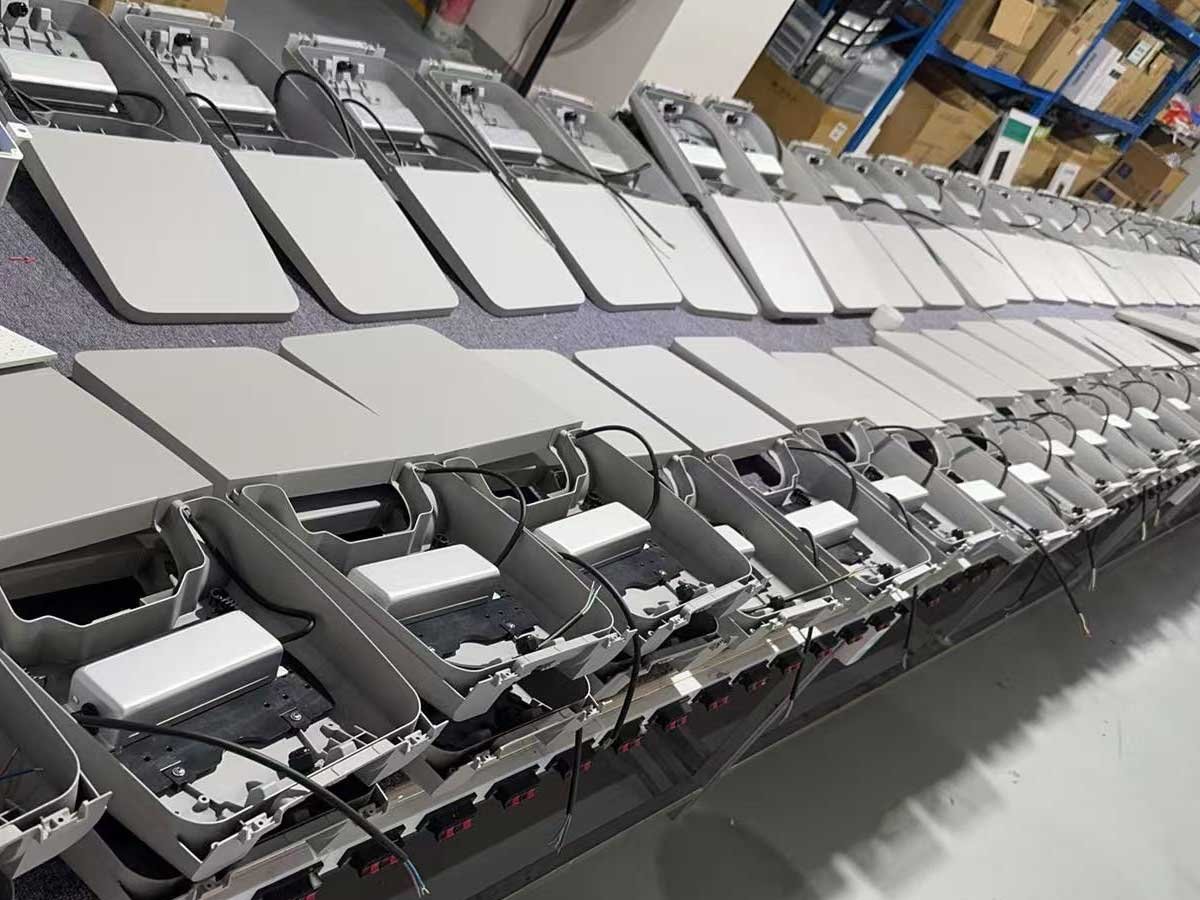
LF-LED08 — 560 chips at 300 W, the widest body of the four
The wide-body series. Housings run 220 to 340 mm deep and take up to 560 chips at 300 W. Both 3030 and 7070 are available — choose 7070 when you want the same current spread over a wider area, which lowers junction temperature and slows lumen depreciation.
| Power | LED qty | Body (mm) | Carton (cm) | Volume | approx. per 20GP |
|---|---|---|---|---|---|
| 50 W | 96 | 220 × 515 × 85 | 38 × 21 × 15 | 0.012 m³ | 2,333 |
| 100 W | 144 | 220 × 565 × 84 | 48 × 27 × 15 | 0.019 m³ | 1,443 |
| 150 W | 240 | 240 × 635 × 85 | 55 × 29 × 15 | 0.024 m³ | 1,171 |
| 200 W | 320 | 290 × 665 × 85 | 58 × 33.5 × 15 | 0.029 m³ | 962 |
| 300 W | 560 | 340 × 810 × 88 | 70.5 × 39.5 × 16.5 | 0.046 m³ | 610 |
- 150–190 lm/W across five tiers — 147.59 lm/W measured at 100 W.
- 3030 or 7070 chips, both available — 7070 spreads the same current over more area.
- 610 units per 20GP at 300 W, 2,333 at 50 W — the highest small-tier density of the four.
A single-piece carton on every tier. Net and gross weight for this series are confirmed per order — ask for them with the quotation.


All four series on one page.
Read across the row you care about. If your tender fixes 195 lm/W and 300 W, only LED03 and LED06 answer — and LED06 stops at 200 W.
| Series | Power range | Tiers | Efficacy | Chips | Beam (50%) | approx. per 20GP | IES |
|---|---|---|---|---|---|---|---|
| LF-LED01 | 50–200 W | 4 | 130–150 lm/W | 3030 · 5050 | 125.3° | 651–1,830 | On request |
| LF-LED03 | 50–300 W | 6 | 150–195 lm/W | 3030 · 5050 | 104.9° | 848–1,717 | On request |
| LF-LED06 | 50–200 W | 4 | up to 195 lm/W | 5050 · 7070 | 101.8° | 866–1,217 | On request |
| LF-LED08 | 50–300 W | 5 | 150–190 lm/W | 3030 · 7070 | 114.3° | 610–2,333 | On request |
All four series can be built to 195 lm/W. That version carries a 500-piece minimum per model, whichever series you pick.
Efficacy figures are goniophotometer measurements. Production units run ±3–5%, as with any LED luminaire. Beam angle is the 50% average.
Container figures are approximate and assume 28 m³ usable volume in a 20GP, one unit per carton. They move with palletisation and with how the container is loaded — confirm against the packing list before you commit to a shipment plan.
What the photometer actually read.
These are the test values behind the efficacy figures above. Each unit sat on a goniophotometer at 25 °C ambient. Ask for the full report against any tier and we send the PDF, not a screenshot.
| Model | Power on test | Flux | Efficacy | Beam (50%) | Upward light |
|---|---|---|---|---|---|
| LF-LED01 | 202.88 W | 28,421 lm | 140.09 lm/W | 125.3° | 0.0% |
| LF-LED03 | 149.32 W | 22,473 lm | 150.5 lm/W | 104.9° | 0.0% |
| LF-LED06 · 7070 | 97.19 W | 18,549 lm | 190.85 lm/W | 101.8° | 0.0% |
| LF-LED06 · 5050 | 200.00 W | 33,057 lm | 165.34 lm/W | 114.3° | 1.0% |
Production units run ±3–5% on efficacy, as with any LED luminaire, so a catalogue number and a test number rarely land on the same digit. Beam angle is the 50% average. LED08 is measured at 100 W at 147.59 lm/W; its full report comes with the IES file.
Where the money actually goes.
3030 or 7070
3030 is the cheaper die and holds up to about 150 lm/W. 7070 drives the same current through a larger area, so the junction runs cooler and output stays flatter for longer — which is why 195 lm/W needs 7070, and why the 7070 package still held 94.7% after 18,000 hours at 105 °C. If your tender scores efficacy, buy 7070. If it only scores lux on the road, 3030 gets you there for less.
T2, T3 or T4
T2 is 60° × 150° — narrow and long, for a two-lane road with the pole on the verge. T3 opens it to 75° × 155°. T4 goes to 95° × 160°, wider and shorter, for a pole at the kerb with a carriageway to cross. Same housing, different lens. Pick from the DIALux result, not from the photograph.
The four series are a platform, not a fixed SKU.
Below is what changes per order and what does not. Anything marked optional is quoted once, then held for every repeat order — so the second shipment matches the first without you re-checking.
| What | Standard | Optional | Why it matters |
|---|---|---|---|
| Optics | Type II or Type III | Custom beam angle | Type II for narrow carriageways, Type III where the pole sits at the kerb and light has to reach across. |
| Driver | Our own brand | Philips · MOSO · Inventronics · MEAN WELL | Name the brand in the PO and it goes in the unit. Nothing to argue about at inspection. |
| LED chip | 3030 on 01, 03 and 08 · 5050 or 7070 on 06 | 5050 · 7070 | Tell us the chip and we confirm which tiers it fits and the MOQ before we quote. |
| Electrical class | Class I | — | Earthed through the pole. Settle this before you order the arm and cable. |
| Beam | T2 — 60° × 150° · T3 — 75° × 155° | T4 — 95° × 160° · custom | T2 for a narrow carriageway with the pole on the verge; T3 where the pole sits at the kerb; T4 to cross a wide carriageway. |
| CCT | 6000 K | 3000 K · 3500 K · 4000 K · 5000 K · 6500 K | Match the rest of the road, or the colour the tender names. |
| Surge | 6 kV line-line at the driver input | SPD module — 10 kA (In) / 20 kA (Imax), Up 1.5 kV | Lightning country. Fitting the module does not change the IP rating. |
| Control | — | ZAGA interface, photocell sensor, networked control | The socket is factory-fitted, so you can add control later without changing the housing. |
MOQ is 200 pieces per model. The 195 lm/W version starts at 500 pieces. Both apply to the four series on this page.
Send us the road. We send back the calculation.
We hold photometric test reports for the tiers on this page, and for any other tier your tender names we commission the IES file — usually the same working day. Send the road width, mounting height, pole spacing and the target lux, and you get the file with the DIALux calculation.
- What we need from you: road width, mounting height, pole spacing, target average lux (and uniformity if the tender states one).
- What you get back: the IES file for the tiers in play, plus a calculation you can drop into your own submission.
- If the numbers do not work: we say so and propose a different tier rather than sending a layout that fails at inspection.
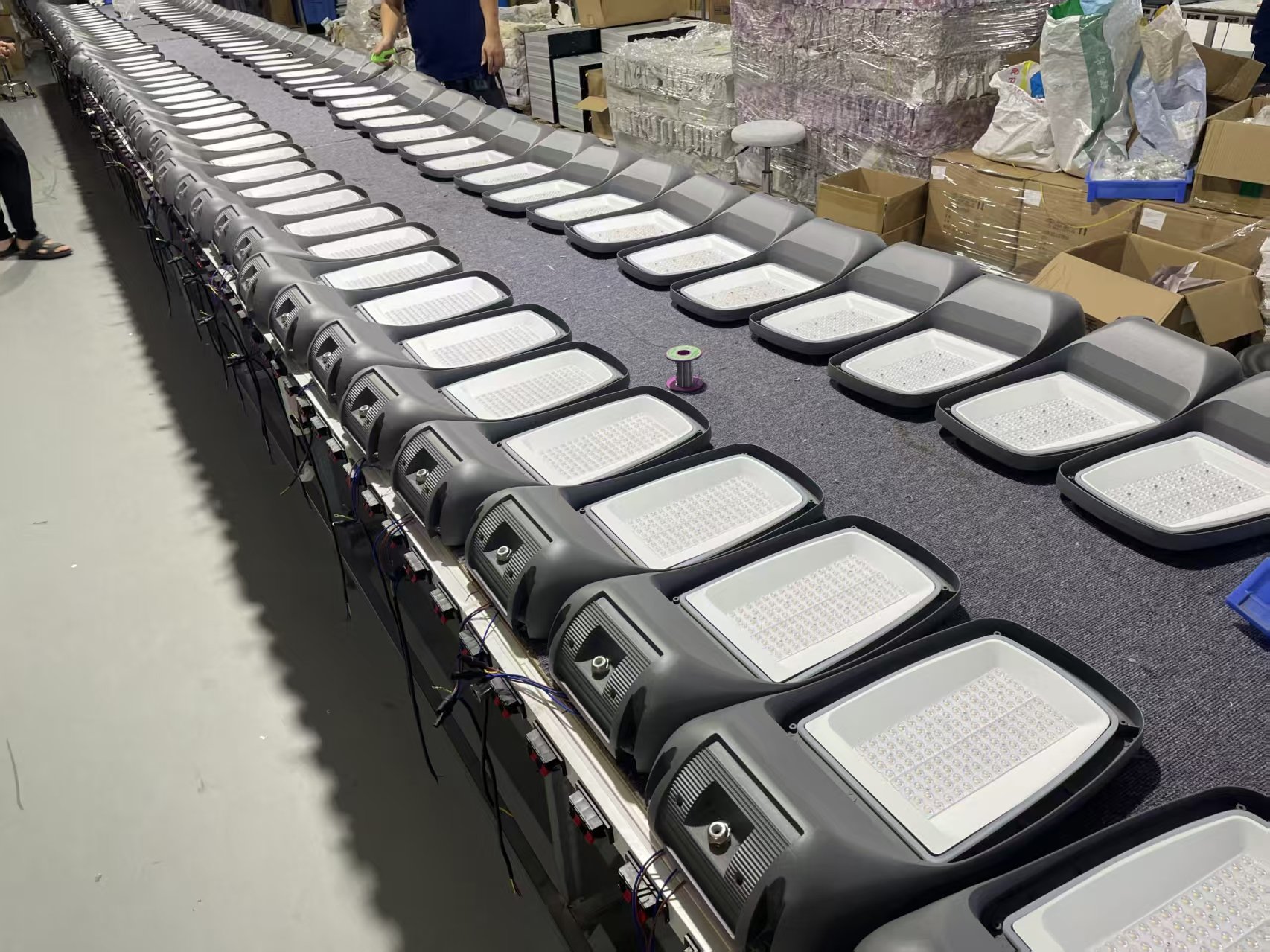
What happens before the unit leaves the line.
Heat path
Before the LEDs go on, we grind the housing face flat and apply thermal grease. That closes the air gap between chip and casting — the most common cause of early lumen loss. All four series go through it; it is not an upgrade.
24-hour ageing
Every unit, not a sample, runs 24 hours at 25 ± 5 °C and 65 ± 10% relative humidity before packing. A driver that drifts in its first day drifts here, not on the pole.
Surface
Five stages before the finish goes hard: polished, passivated, anodised, outdoor-grade powder coated, then baked. Passivation sits between the polishing and the anodising; the anodising protects the aluminium itself, the powder takes stone chips and UV, the bake cures it. A 48-hour salt spray is run as a production check.
Sealing and surge
Class I, IP65 with a moulded gasket on the driver compartment, and 6 kV line-line surge handling at the driver stage before any optional SPD module is added.

Three years, with five and seven where the tender asks.
Same terms on all four series. The optional terms are priced with the order, not bolted on afterwards.
| Series | Standard | Optional | What it covers |
|---|---|---|---|
| LF-LED01 · 03 · 06 · 08 | 3 years | 5 years · 7 years | Driver and LED module failure under normal operating conditions |
What the schedule actually looks like.
| Stage | Time | What to plan around |
|---|---|---|
| Sample | 3 days | Sample cost is credited against the first bulk order. |
| Standard production | 20 days | From deposit and approved artwork. |
| Rush production | 15 days | Tell us at the quotation stage, not after the PO. |
| Daily capacity | 300–500 units | Across the whole street light line, not one series. |
What buyers ask before they shortlist us.
Can you meet a specified lux level?
Send the road width, mounting height, pole spacing and the target average lux. We run DIALux and send the calculation with the IES file. If a tier cannot reach the level, we say so and propose another rather than let it fail at inspection.
Do you supply IES files?
Yes, on all four series. For the tiers we have already measured the file goes out as it is; for any other tier we commission the test and usually send the file the same working day. No form to fill in.
What is the MOQ?
200 pieces per model. The 195 lm/W version starts at 500 pieces per model, on any of the four series. The two thresholds apply independently.
Can you fit a driver brand we already approve?
Philips, MOSO, Inventronics and MEAN WELL are all available as options. Our own driver is standard. Name the brand in the PO and it is what goes into the unit.
T2, T3 or T4?
All three are standard, no price difference and no MOQ change. T2 is 60° × 150° for narrow carriageways and long throw; T3 is 75° × 155°; T4 is 95° × 160° for a pole at the kerb with a wide carriageway to cross. Same housing, different lens.
Is surge protection included?
6 kV is built into the driver stage on every model. An optional SPD module rated 10 kA (In) / 20 kA (Imax), Up 1.5 kV, can be added, and fitting it does not change the IP rating.
What warranty do you offer?
Three years standard on all four project series, with five and seven-year terms available where the tender specifies them. Terms are quoted with the order.
Can you handle a mixed order across series?
Yes. Every tier ships in a single-piece carton, so a mixed pallet does not mean opening cartons. MOQ applies per model, not per order.
Send us the road, not just the wattage.
Road width, mounting height, pole spacing, target lux. We come back with a tier, an optics choice and a DIALux calculation — usually the same day.